Search



News
FoMA Trustee Christopher Deliso interviews Chris Mellen, President of FoMA’s sister charity, the Mount Athos Foundation of America, who was newly returned from a visit to the Ecumenical Patriarchate in Istanbul and the Holy Mountain. The Q & A introduces FoMA members to MAFA – its origins, what differentiates it from FoMA, and its future goals.

Christopher Deliso: There are many Greek Americans who, like you, have a business background. Yet few have chosen to volunteer their time and knowledge to create a charity supporting the Holy Mountain. How did you get the idea for MAFA, and how did the process of beginning it start?
Chris Mellen: Following pilgrimages to Mount Athos in 2014 and 2016, I met Bob Allison [a past MAFA president and founding member] in September 2016. From the beginning I knew it would be a challenge, as he told me that previous attempts to form an American organization of this type had never materialized. The combination of Bob’s deep experience with both the Athonite Community and FoMA, my business background and initiative, and the efforts of a few other American FoMA members made it happen. MAFA was formally established on April 30, 2018.
CD: How is MAFA different from FoMA, given that they are sister charities and that MAFA is much the younger as a charity?
CM: MAFA is purely a foundation that enables Americans to make tax-deductible donations for the benefit of the Athonite Community. It is seen as a complement to FoMA. As such, it is not a membership group and it does not lead tours or publish. MAFA encourages donors to become members of FoMA.
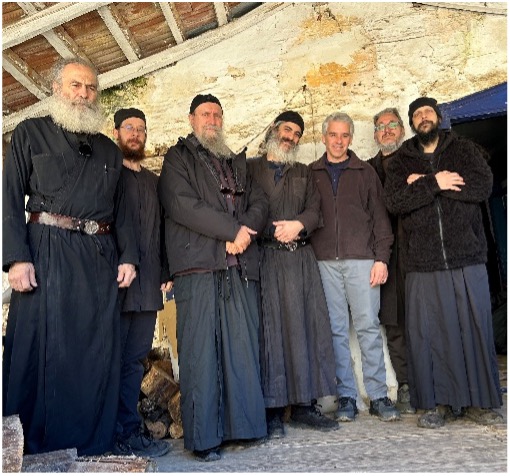
Chris with the monks of Axion Estin
CD: What are the different appeals MAFA has conducted?
CM: MAFA has conducted two types of appeals – some for emergencies, when cash is needed at short notice, and others to support projects. Two examples of emergency appeals are in response to a fire at Grigoriou Monastery and in response to a landslide at the Kalyva of the Dormition. Two examples of project appeals are for the Axion Estin Cell and the St. John the Forerunner Convent on Mt. Kissavos.
CD: How do you identify new fundraising opportunities for both specific monasteries and cells? Does MAFA isolate need first, or await the requests of the Holy Mountain? And does MAFA have any particular strategies regarding finding potential donors and supporters?
CM: The key to our fundraising efforts is to make American pilgrims and supporters of Mount Athos aware of MAFA’s existence. Through the tireless efforts of our Liaison in Greece, Konstantinos Dolmas, along with several of our board members who have made pilgrimages to Mount Athos in recent years, we have introduced MAFA to the monasteries, sketes, and cells and have encouraged them to tell pilgrims about MAFA. In addition, a little over a year ago, we brought in James Carras, a fund-raising professional, to join the Board and lead its Development Committee. Third, we have held two exhibitions. Finally, board members are encouraged to get the word out and to directly ask for donations.
CD: A significant recent example of honoring donor intention regarded MAFA’s facilitation of a will from a late Greek American to a certain Athonite monastery—a four-year process, as it turned out. What did the board learn from this experience, and to what extent can it serve as educative for future similar donations?
CM: This is exactly one of the visions for the purpose of forming MAFA. This particular will is providing for a small but helpful amount of income every year into perpetuity (an annuity) for this monastery. Had MAFA not existed, there would have been no way for this money to be distributed as the decedent had intended, given certain probate laws. The attorneys found MAFA, met with two MAFA board members, and established a system to make an annual distribution to MAFA, which will in turn send the funds to the monastery.
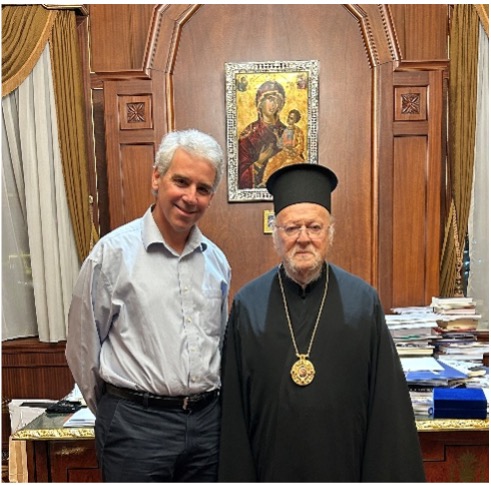
Meeting the Ecumenical Patriarch
CD: One way MAFA distinguished itself early on was its traveling exhibitions about the Holy Mountain. What made you consider this model, and what are the rewards and challenges? In your opinion, is it the sort of thing FoMA might do for a British audience, or are the local conditions too different?
CM: In 2019, MAFA signed an MOU with the Agioreitiki Estia (Mount Athos Center in Thessaloniki). This has proven to be a tremendous and mutually beneficial relationship and effort. They put together two exhibitions – The Ark of Orthodoxy and Princeton’s Hidden Treasure, Mount Athos and Meteora 1929. MAFA worked with the Maliotis Cultural Center in Boston to host Ark in 2022 and Princeton in 2024. Both have since been exhibited in other venues. This is consistent with part of MAFA’s mission to “foster knowledge and understanding of the monastic communities” and it promotes MAFA. The challenges mostly revolve around logistics. I absolutely think this is something that can and should be done in Britain.
CD: How do you look to encourage endowments in the future for MAFA?
CM: Statistics show that it takes a long time (20 years on average) for a non-profit to have meaningful endowments. MAFA is fortunate enough to have a relatively small ($100,000) endowment thanks to a couple who passed away in 2022-23. Beyond that, we have formed the St. Paisios Society with MAFA to encourage legacy giving and have put together a Legacy Giving Guide that can be found on our website.
CD: Does MAFA plan to do publications or tours like FoMA does?
CM: No. FoMA has done an excellent job on both fronts for many years. MAFA is not looking to compete with FoMA in any way. If donors to MAFA are interested in publications and tours, we can direct them to FoMA.
CD: What is the charity’s growth strategy and timeline?
CM: In January, we passed a milestone of raising a total of $1 million since our formation! Most of this has come in the last four years, when we have averaged just over $200,000 per year in donations since 2022. I am hoping we exceed $300,000 in 2026 and we consistently exceed $500,000 per year in 2028 and beyond. This will depend on increased awareness of our existence, MAFA’s fundraising efforts led by our Development Committee, and the generosity of those who have a love for both Mount Athos and the monks who pray incessantly for us and support us spiritually.
CD: In your opinion, is there a potential risk of competition between the sister charities, or do they possibly have complementary roles? Are there any specific cases or examples or possibilities for future cooperation you could consider, such as joint appeals or events?
CM: I don’t see competition, I see complement. MAFA is not about MAFA, it is about helping the Athonite Community. MAFA is comprised of an all-volunteer board working part-time on this effort, given that most have full-time jobs. As such, our time is limited and we need to be laser focused that any efforts we are making are toward aiding the Athonite Community. Several MAFA board members are, or have been, active with FoMA as well. So the dialogue between the two organizations is active and ongoing. I see more opportunities for future cooperation to be through joint appeals (such as that for the Axion Estin cell) than for events.
In a supplement titled “Our Places,” the Greek newspaper Kathimerini published an...
Read MoreThis year’s Madingley Conference is devoted to the theme Holy Beauty: The...
Read MoreOn Sunday, June 14, 2026, in Karyes, Mount Athos, the customary ceremony...
Read More8–15 May 2026 Earlier this month, members of the Friends took part...
Read More