Search


FoMA’s annual Autumn Meeting took place on 6 November this year at St Dunstan’s Church in Fleet Street, London, and featured a fascinating talk on the history and current status of Romanian monasticism on the Holy Mountain.
The talk was scheduled to be given by the recently appointed Romanian Archbishop of London, Archbishop Atanasie. Unfortunately, the Archbishop was unable to be with us at the last minute due to an urgent commitment and we are very grateful that his assistant, the Reverend Hieromonk Dionisie, ably stepped in to present the Archbishop’s talk on his behalf.
Hieromonk Dionisie described the Romanian presence on Mount Athos from its earliest beginnings with humble pilgrimages in the Middle Ages by people from Moldavia, Wallachia and Transylvania, through the work of numerous Romanian benefactors and protectors of the monasteries, and finally to the founding of the two current Romanian houses on Mount Athos – the cenobitic Skete of Prodromos, belonging to the Great Lavra Monastery, and the small Lakkoskiti monastic village in the northern foothills of the Mountain.
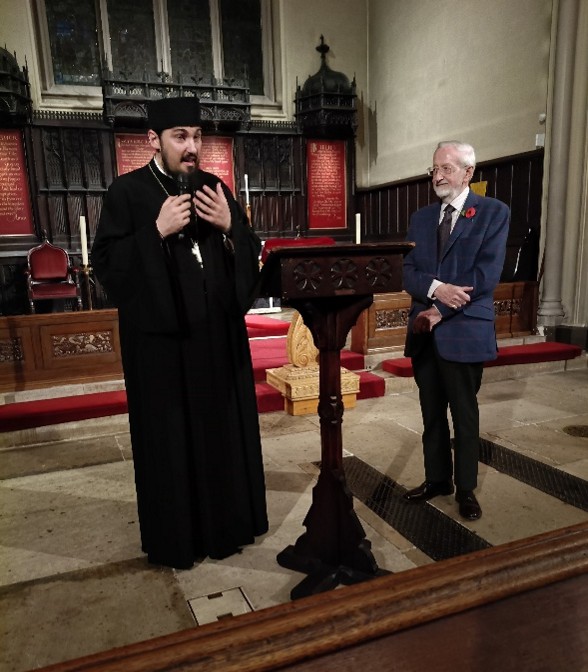
He characterised the Romanian presence as ‘organic’, saying Romanian liturgical language had been preserved but had also become fully integrated into the Athonite federation. Romanian princeling benefactors across the centuries had been responsible for providing a flow of aid to Mount Athos monasteries especially in the difficult years of Ottoman rule, which had proved a vital lifeline for the monks. Some examples of practical Romanian support included the rebuilding of Simonopetra Monastery after a fire in 1580, and the establishment of the Bucharest Press from which many Greek, Arabic and Slavonic books found their way into Athonite services. This, he said, had greatly helped to ensure that the ‘flame of prayer’ on Mount Athos had never been extinguished and had helped to shape the spiritual history and culture of the Mountain.
Hieromonk Dionisie then spoke about the lives of some of the Romanian saints who had been active on Mount Athos over the years, including Elder Dionysios of Vatopedi of the Cell of St. George Kolitsou, and Hieromonk Petronios, former Dikaios (Prior) of the Skete of St. John the Forerunner under the Holy Monastery of Great Lavra, who have very recently been canonised by the Orthodox Church. He concluded by describing Athos as ‘a living anchor’ in the Romanian diaspora where faith was not isolated but part of a shared heritage. Romanian saints, he said, provided a ’living bridge’ between Athos and the people of Romania.
After the talk, an informal reception in the church building gave the opportunity for around 25 attendees to mingle and talk together with Hieromonk Dionisie and FoMA committee members over wine and refreshments.