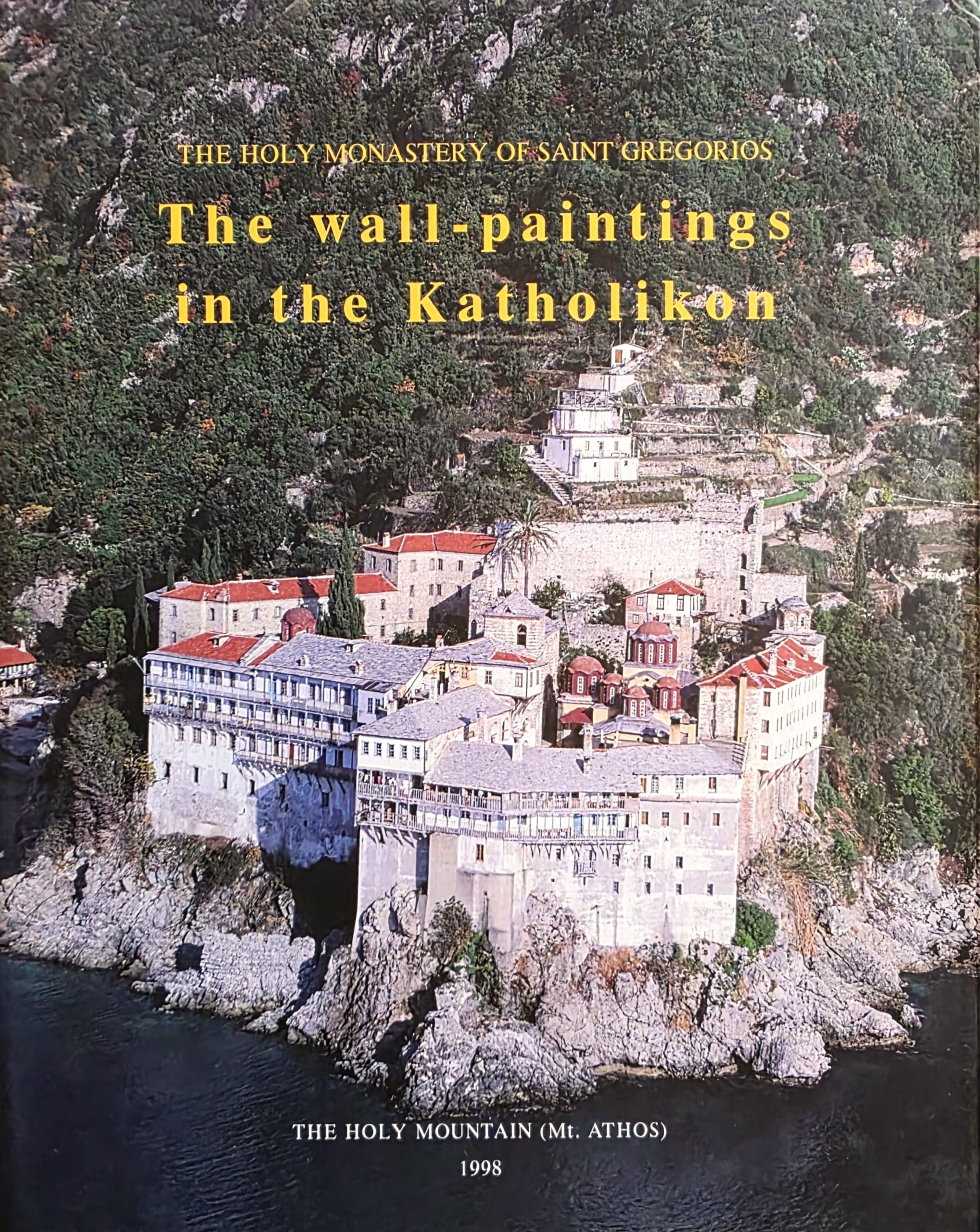
In The Holy Monastery of Saint Gregorios: The Wall-Paintings in the Katholikon, authors Nikos Zias and Sotirios Kadas present the wall paintings of the katholikon of the Monastery of Gregoriou on Mount Athos, executed between 1768 and 1779 by Kastorian painters. Richly illustrated and clearly organised, the volume combines detailed description with historical and theological analysis, offering a model study of Athonite art.
Zias and Kadas are leading scholars of Byzantine and Post-Byzantine art. Kadas’s Mount Athos: The Monasteries and Their Treasures has become a classic pilgrim’s guide, and he has catalogued hundreds of Athonite illuminated manuscripts. Zias, long associated with the European Centre of Byzantine and Post-Byzantine Monuments, has contributed significantly to the study of Byzantine art’s reception in modern Greek painting. Their collaboration results in an accessible yet scholarly volume appealing to both specialists and general readers.
The book focuses on the wall paintings of the katholikon (main church) of Gregoriou Monastery. An inscription records that the decoration was executed by the priest-monk Gabriel and a painter named Gregory, both from Kastoria, between 1768 and 1779. The church itself had been rebuilt after a devastating fire in 1761. The monastery, dedicated to Saint Nicholas, dates to 1310 and was founded by Gregory the Younger, a disciple of Gregory of Sinai.
Athonite wall painting is typically divided into three phases: Late Byzantine, early post-Byzantine (notably the sixteenth-century Cretan school), and early modern (eighteenth–nineteenth centuries). The paintings at Gregoriou belong to this last phase. The church, modest in size, follows the standard Athonite triconch plan, a variation on the cross-in-square type. The invitation of painters from Kastoria – a regional artistic centre – attests to their reputation.
The decorative programme is extensive and coherent. It includes a full Christological cycle, scenes of Christ’s parables and miracles, and abbreviated cycles of the Virgin, John the Baptist, and Saint Nicholas. The Marian programme is enriched with scenes from the Akathistos Hymn. The lity (narthex) contains especially rich imagery. Overall, the iconographic scheme broadly follows the prescriptions of Dionysios of Fourna’s Painter’s Manual (1730-1734), though not rigidly, allowing for flexibility and invention.
Eighteenth-century iconography has often been dismissed as decadent or provincial. While the Kastorian painters were less formally trained than earlier masters and used simpler materials, their style is nonetheless distinctive. It features bold, saturated colours – especially red, blue, gold, and white – dense, figure-filled compositions, and elaborate ornamental patterns, particularly in garments. Western influences are also evident in certain motifs and iconographic choices.
Despite such criticisms, the paintings at Gregoriou include striking works. The Platytera in the apse depicts the Virgin in gold garments holding a cosmic orb bearing the symbols of the zodiac. Other notable images include a distinctive Pentecost, with the Theotokos seated at the head of the Apostles; a dramatic Transfiguration with Christ in a mandorla of turning gyres; and extensive use of highly inventive and complex architectural backdrops. Especially impressive are the large figures of Christ, the Virgin, and Saint Nicholas in the lity, whose refined modelling and commanding presence reveal considerable nuance and skill.
The volume is handsomely produced, with nearly three hundred high-quality colour images – about a third of the book – supported by seventeen full-page architectural plans mapping the paintings. Kadas provides detailed descriptions, while Zias addresses historical, stylistic, and theological aspects. The result is a model study of Athonite art.
Book details: Nikos Zias and Sotirios Kadas, The Holy Monastery of Saint Gregorios: The Wall-Paintings in the Katholikon. Mount Athos, 1998. 311 pp. + 270 colour plates, 17 architectural plans. Price: £35 (plus shipping).


 Secure payments
 Shipping worldwide
 Packaged with care
 Recyclable packaging